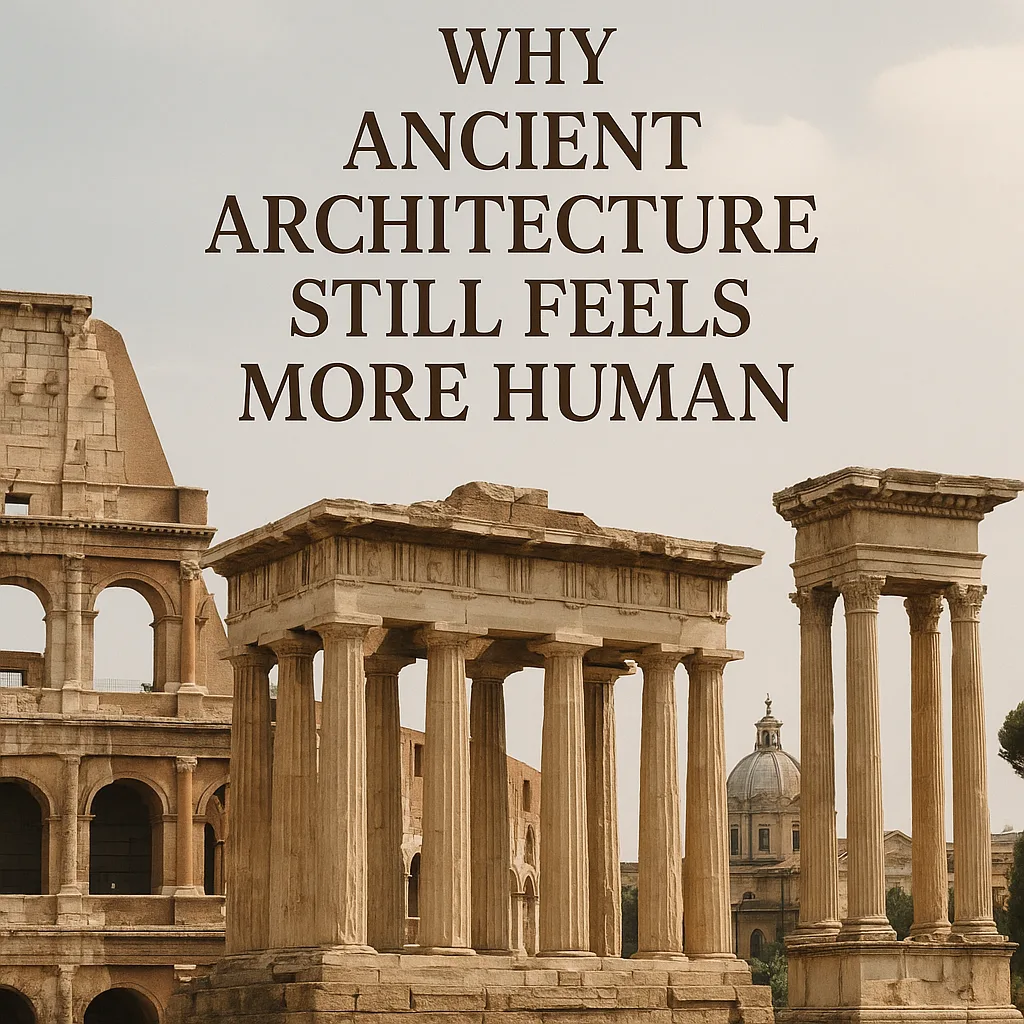
In spite of their age, historical structures frequently feel more alive and human than many of the glass-and-steel skyscrapers that dominate our contemporary skylines. This is evident as you stroll through the ruins of Athens, the winding lanes of Rome, or the eternal temples of India. We are drawn to ancient architecture more than we are to clean minimalism or imposing megastructures.
Why is that? Why does old building have such a persistently human feel? Scale, craftsmanship, symbolism, and the cultural tales etched into stone hold the key to the solution. These structures were more than just buildings; they were manifestations of human values, creativity, and life.
Built on a Human Scale
One of the most striking features of ancient architecture is how it was designed with the human body in mind.
-
Proportions that fit us: Even though the Parthenon in Athens is enormous, its columns, steps, and spaces are all proportioned to be harmonious with the human eye. Instead of feeling overpowered by the design, you may stand in front of it and feel like you're a part of it.
-
Spaces for gathering: Plazas, courtyards, and public spaces where people could congregate, converse, and live together were given top priority in ancient design. Contrast that with contemporary cities, where areas frequently put efficiency, traffic, or business ahead of interpersonal relationships.
-
Integration with the environment: Rather than working against nature, ancient architects worked with it. Stepwells in India reacted to seasonal rains, temples in Greece orientated themselves towards the rising sun, and cliff houses in Mesa Verde blended in with the rock sides. This environmental awareness strengthened a feeling of inclusion in the world rather than dominance over it.
The Craft of Hands
With its reliance on machines, prefabrication, and homogeneity, modern architecture frequently prioritises speed and cost-effectiveness. On the other hand, human hands can still be seen in ancient structures.
-
Stone carving and ornamentation: Reliefs were sculpted, columns were chiselled, and ornamental motifs conveyed narratives. Each building was given a sense of individuality and distinctiveness by these additions.
-
Local materials: Limestone, marble, mud brick, timber, and other materials with texture, irregularity, and warmth were used by ancient builders. These materials captured the essence of their locations, in contrast to the uniform steel or glass panels of today.
-
The labor of generations: The construction of many buildings takes decades or even centuries. As we stroll among the remains, we feel the continuity of the patience, tenacity, and craftsmanship of innumerable people etched into every stone.
The tactile, imperfect beauty of these handmade creations connects us to the humanity of their makers.
Symbols in Stone
Ancient architecture always had a purpose in addition to providing shelter. Each component had civic, religious, or cultural significance.
-
Temples and spirituality: Indian temples depicted myths in their carvings, Mayan temples mirrored cosmic cycles, and Egyptian pyramids lined up with the stars. These were theologies in stone, not just structures.
-
Civic pride: The combined might of the populace and the empire was symbolised by Roman amphitheatres, aqueducts, and forums. People recognised themselves in these pieces.
-
Cultural storytelling: Stories of gods, heroes, and towns were depicted in mosaics, murals, and reliefs. The building itself served as a narrative canvas.
In contrast, modern architecture frequently eschews symbolism and ornamentation in favour of simple lines and practicality. Although effective, they can come across as aloof, meaningless, and unconnected to the human mind.
Time as a Dimension
Ancient architecture reminds us of time in ways modern structures rarely do.
-
Built to last: Aqueducts, pyramids, and temples were constructed for eternity rather than for immediate financial gain. Their perseverance is indicative of a mindset that emphasised legacy and continuation.
-
A patina of age: The crumbling steps, moss-covered walls, and weathered stones all bear witness to the innumerable lives that have passed here. Every sign of erosion gives these structures personality and serves as a reminder that they belong to all succeeding generations as well as their original architects.
-
Continuity of culture: These structures endured throughout empires, serving as a reminder of the timeless qualities of human life—belief, beauty, and community—that cut beyond politics and the economy.
You feel the weight of time when you enter a mediaeval church or stand in front of Machu Picchu's ruins; this reminds you of humanity's common history.
Contrast With Modern Architecture
Smooth skyscrapers, minimalist homes, and environmentally friendly smart structures are some of the wonders of modern architecture. However, it frequently puts spectacle, efficiency, or scale ahead of personal warmth.
-
Skyscrapers dwarf us: Their size is stunning, yet it can make us feel like ants and alienate us. Despite their enormous scale, ancient buildings managed to strike a balance between majesty and human proportion.
-
Minimalism erases warmth: Particularly when they lack depth or story, crisp lines and barren surfaces might come across as antiseptic. Ornament and irregularity were welcomed in ancient architecture because they seemed alive.
-
Functional but soulless:Many contemporary designs place more emphasis on branding or functionality than on the multi-layered meanings and cultural resonance of classic pieces.
This is not to argue that contemporary architecture lacks humanity—some designs combine social space, art, and sustainability—but the contrast demonstrates why we still find older buildings to be more human.
Lessons From Ancient Architecture
So what can we take from the ancients as we build the cities of the future?
-
Design for people, not just scale. By providing areas for gathering, introspection, and a sense of belonging, architecture should promote human connection.
-
Honor craftsmanship. Even in contemporary settings, handmade elements serve as a reminder of creativity and uniqueness.
-
Use materials with soul. Local materials and natural textures can provide our surroundings cosiness and personality.
-
Embed meaning. Buildings should tell stories, reflect culture, and inspire awe, not merely serve as functional shells.
-
Think long-term. Rather than being a throwaway item, architecture can endure and act as a link between generations.
Why Ancient Architecture Endures in Our Hearts
Ancient building appeals to us not just because it is old or magnificent, but also because it captures the essence of humanity. It expresses our need to connect with forces greater than ourselves, to tell stories, to create beauty, and to belong.
Ancient architecture reflects the human condition—fragile, transient, yet aiming for something eternal—in its flaws, textures, and symbolism. It connects the past and present and serves as a reminder that although civilisations change over time, the human spirit never changes.
Conclusion
Because it was constructed with people at its core, ancient architecture still has a more human feel to it. It was handmade, crafted to fit the human body and imagination, and brimming with tales that provided purpose to existence. These buildings, in contrast to many contemporary ones, were aspirational, spiritual, and intensely communal in addition to being useful.
We feel the pulse of our ancestors when we stand among the ruins or within restored temples; we don't just see stone and mortar. And that heartbeat never stops reminding us of what building means for mankind as a whole, not simply for efficiency.