Introduction
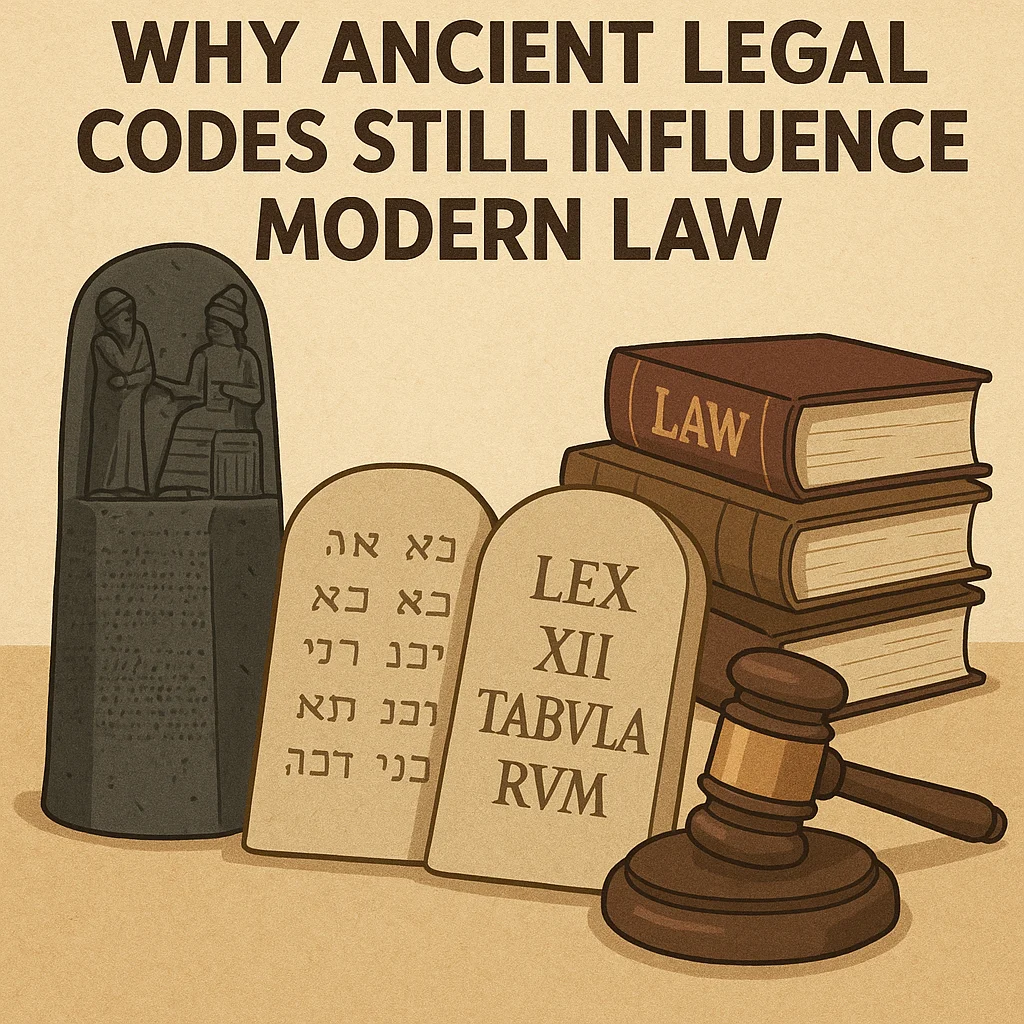
It is common to refer to the law as a living system that is dynamic, responsive to human needs, and ever-evolving. Many of the tenets that underpin contemporary law, however, have their origins in the earliest civilizations and date back thousands of years, despite centuries of development. Roman law, the Code of Hammurabi, and even Greek and biblical customs are examples of ancient legal codes that continue to influence modern legal systems.
In a world of international treaties, digital contracts, and artificial intelligence, why do these antiquated systems still have an impact on us? The universality of human problems—how to control conduct, settle conflicts, maintain justice, and maintain order—holds the key to the solution. The basic questions don't change despite changes in culture and technology.
This blog investigates the reasons behind the continued influence of ancient legal codes on contemporary law, the ways in which their legacies can be seen in contemporary institutions, and the insights they provide into the persistence of human civilization.
1. The Code of Hammurabi: The First Written Law
The Code of Hammurabi, one of the oldest known legal codes, was created in Babylon circa 1754 BCE. It set forth laws pertaining to trade, property, family, and punishment and was carved into stone pillars. Its form—it was available to the public—as well as its content are important.
Key legacies that still resonate today:
-
Written laws as a source of authority: Codification is emphasized in contemporary legal systems. The idea of putting laws in writing is the foundation of statutes, constitutions, and regulations.
-
Proportional justice: Even though contemporary systems favor rehabilitation over retaliation, the concept of "an eye for an eye" influenced the idea that punishment should be proportionate to the crime.
-
Standardization of justice: Predictability, a key component of modern legal stability, was established by laws that were applied uniformly to all members of the population.
Hammurabi established the foundation for the idea of transparency in governance by enshrining laws for public viewing.
2. Mosaic Law and Religious Influence
Modern legal theory has also been impacted by the legal traditions found in the Hebrew Bible (Torah), also known as Mosaic law. It brought aspects of law that went beyond effective governance with its focus on morality, social justice, and divine accountability.
Key contributions:
-
Ethical foundations of law: Later Western moral-legal traditions were influenced by ideas like justice, integrity, and respect for human life.
-
Social protections: Provisions for widows, orphans, and strangers prefigured modern welfare laws.
-
Sabbath rest: Modern labor laws, such as those pertaining to weekend and working-hour restrictions, were influenced by the notion that humans require rest.
Discussions concerning the interplay of religion, ethics, and secular justice continue to be influenced by the incorporation of morality and law in Mosaic codes.
3. Greek Contributions: Democracy and Natural Law
The ideas of democracy and natural law, which are essential to contemporary legal systems, were brought by ancient Greece, especially Athens. Ideas that are still included in legal theory today, such as justice, equality, and governance, were discussed by philosophers such as Aristotle and Plato.
Notable influences:
-
Trial by jury: Citizen juries were used in ancient Athens, and contemporary democracies have directly adopted this concept.
-
Equality before the law: All constitutional democracies around the world uphold the idea of isonomia, or equal law for all citizens.
-
Philosophical grounding of law: Centuries later, Enlightenment intellectuals were influenced by the notion that laws ought to be in accordance with human nature and reason, which was first proposed by thinkers such as Aristotle.
Greek ideas about law as something logical, universal, and based on human dignity are greatly influenced by modern legal systems.
4. Roman Law: The Backbone of Modern Legal Systems
Roman law has had a greater impact on modern law than any other ancient system. Both common law and civil law traditions were influenced by the complex legal system that the Roman Empire established.
Key legacies:
-
Civil law codification:Many European legal systems are based on the Roman Corpus Juris Civilis (Body of Civil Law), which was assembled under Emperor Justinian.
-
Property and contract law: Modern doctrines and Roman definitions of ownership, contracts, and obligations are remarkably similar.
-
Legal professionals: The foundation for contemporary legal professions was laid by the Romans, who codified the roles of advocates, judges, and jurists.
-
Presumption of innocence: This idea, which is fundamental to the criminal justice system of today, was applied in Roman courts.
Europe, Latin America, and even regions of Africa and Asia that have embraced civil law traditions are particularly notable for their Roman legacies.
5. Medieval Legal Codes: Bridging Ancient and Modern
Medieval Europe inherited and reinterpreted ancient codes as the Roman Empire began to decline. While preserving earlier ideas, feudal codes and canon law (church law) introduced new levels of complexity.
Key contributions:
-
Common law in England: Developed in the Middle Ages, common law was built on precedent—a Roman-inspired principle—eventually forming the basis of U.S., Canadian, and Australian systems.
-
Magna Carta (1215): Rooted in both Roman and biblical traditions, it emphasized rights against arbitrary power, influencing constitutional democracies worldwide.
-
Universities and legal education: Medieval scholars preserved Roman legal texts, ensuring continuity.
This period demonstrates how ancient ideas never disappeared but evolved through reinterpretation.
6. Why Ancient Codes Endure: Universal Human Concerns
The persistence of ancient legal codes isn’t accidental—it reflects the timeless nature of certain human concerns.
-
Property and ownership: Controlling property ownership has always been important, from Hammurabi to contemporary real estate law.
-
Contracts and promises: Trust between individuals and institutions requires enforceable agreements.
-
Crime and punishment: Every society struggles to strike a balance between justice and mercy while preventing harm.
-
Social order: Laws serve to stabilize societies, regardless of time period.
Because these needs are universal, ancient solutions remain relevant even in modern legal frameworks.
7. Modern Examples of Ancient Influences
-
U.S. Constitution: Inspired by Roman ideas of republican governance and Greek democracy.
-
Civil law in Europe: Direct descendant of Justinian’s codification of Roman law.
-
Trial by jury: A practice with deep roots in ancient Athens.
-
International human rights: Concepts of natural law, originating in Greek and Roman philosophy, heavily influenced the Universal Declaration of Human Rights.
Discussions in ancient societies are reflected in current debates, such as whether punishment should be retributive or rehabilitative.
8. The Balance Between Tradition and Innovation
Modern systems are still influenced by ancient legal codes, but they must also change. In Hammurabi's day, problems like artificial intelligence, climate change, and digital privacy were unthinkable. Nevertheless, we can begin addressing new issues by using the frameworks that were developed thousands of years ago.
-
Constitutional frameworks evolve but retain ancient principles like fairness and equality.
-
International law borrows from Roman traditions of treaties and citizenship but applies them to global governance.
-
Digital contracts use the same logic as Roman agreements, adapted to electronic platforms.
The ability of ancient law to evolve alongside human progress explains why it still matters today.
Conclusion
The tenets of ancient legal codes, whether they are enshrined in stone tablets or discussed in long-gone forums, may seem remote, but they serve as the cornerstones of contemporary legal systems. The foundation of modern law is unquestionably ancient, ranging from Hammurabi's transparency to Roman codification, Greek equality, and Mosaic morality.
This continuity demonstrates that, rather than a lack of innovation on the part of humanity, our most important questions—how do we strike a balance between freedom and responsibility—remain strikingly constant. How can justice be upheld? How can we coexist in harmony?
Despite its complexity, modern law is a conversation with the past. Ancient codes are still in use because they encapsulate the fundamentals of human society's governance, not because they are antiquated artifacts.