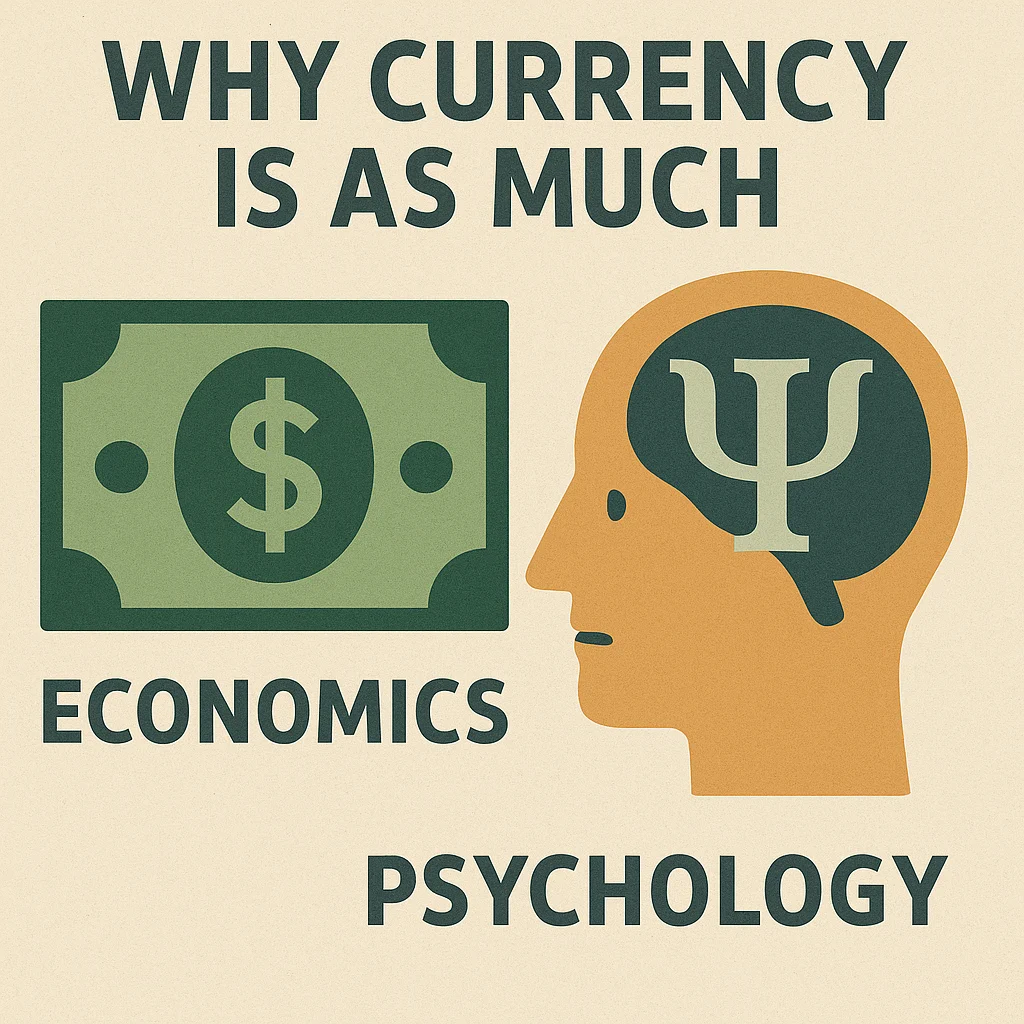
Hard figures, balance sheets, and economic charts are frequently what come to mind when we think about money. We consider currency to be a purely financial instrument that is quantified by supply, demand, and exchange rates. But if we look more closely, we see that money is psychology as much as economics.
People think currency works, so it does. There is no actual intrinsic value to a piece of paper, a metal coin, or a digital number displayed on a screen. Its power comes from society's overall perception, confidence, and trust. The history of money is as much about human psychology as it is about economics, from the use of salt and seashells in ancient marketplaces to the current use of Bitcoin and central bank digital currencies.
The Illusion of Value
What gives a dollar bill its worth? It is no longer supported by gold or silver. It cannot be used as clothing, consumed, or incorporated into a building. Its worth is wholly determined by social consensus. Because others do, we accept it.
As a result, one of the greatest psychological innovations in human history is currency. In contrast to food or tools, money is abstract and necessitates shared belief. No amount of legislation or coercion can keep a currency valuable once people lose faith in it. Examples of hyperinflation destroying money overnight because people lost faith in it abound in history.
Money as Collective Imagination
According to anthropologists, one of humanity's "shared fictions" is money. It only exists because a sizable portion of the population agrees to behave as though it does, just like religion, the law, or nationality.
-
A U.S. dollar is worth something in Tokyo because millions of people across the globe agree it has value.
-
A Roman denarius was accepted across the empire because soldiers, farmers, and merchants shared belief in it.
-
A cryptocurrency like Bitcoin only holds value because a network of users trusts in its scarcity and security.
This shared imagination is fragile but powerful. Unlike armies or governments, it transcends borders.
The Psychological Foundations of Currency
Economists use supply, GDP, and inflation to gauge currency. On the other hand, psychologists study how human behavior supports it. The power of money is driven by several psychological forces:
1. Trust
The basis of currency is trust. When you accept money, you're putting your trust in other people to do the same. Central banks put forth a lot of effort to uphold this trust by being transparent and stable.
2. Scarcity
People appreciate limited resources. Gold has long been valued due to its durability, scarcity, and mining difficulty. Similarly, by restricting its supply to 21 million coins, Bitcoin takes advantage of scarcity. Just as much of a psychological trigger as an economic one is scarcity.
3. Status and Identity
Currency serves as a symbol of identity and power in addition to being a means of exchange. American influence is projected by the US dollar. European unity is symbolized by the euro. Even cryptocurrencies have cultural significance because their use denotes affiliation with a particular group or philosophy.
4. Fear of Loss
Emotions like fear, greed, and anxiety influence how people relate to money. A psychological concept known as loss aversion demonstrates that people are more driven by the fear of losing money than by the chance to acquire it, according to behavioral economics.
5. Herd Behavior
Collective behavior determines whether a currency flourishes or fails. A currency's collapse is accelerated when people rush to get rid of it because they think it will fall. On the other hand, money gets stronger when confidence increases. "Rational" economics may not be as important as this herd psychology.
Historical Examples of Psychology in Currency
Ancient Shell Money
In the past, cowrie shells were used as money in Asia and Africa. Despite their lack of usefulness, they were prized for their beauty, rarity, and widespread recognition. It was not utility that made them valuable, but psychology.
Salt and the Roman Soldiers
Salaryum, the salt that Roman soldiers were occasionally paid with, is where the word "salary" originates. In addition to its practical uses, salt was prized because it was seen as a symbol of stability and life.
Hyperinflation in Weimar Germany
German marks lost all of their value in the 1920s. To purchase bread, people carried wheelbarrows full of cash. The collapse was psychological as well as economic. No amount of printing could make the mark valuable again once people had lost faith in it.
Bitcoin and Digital Scarcity
Perhaps the most obvious example of money as psychology in the modern era is Bitcoin. It has no inherent purpose, no supporting government, and no physical existence. Millions of people, however, value it due to their belief in decentralization, scarcity, and trust in technology.
Why People Obey Money More Than Laws
Money commands more obedience than many laws or governments, which is fascinating. Even though a government can enact laws, people may oppose them if they don't think they are legitimate. On the other hand, currency encourages voluntary compliance.
Why? Because the need for social belonging, the fear of scarcity, and the desire for security are all aspects of human psychology that money appeals to. Money offers immediate, palpable advantages, unlike laws. It appeals to our emotional and logical sides.
The Fragility of Money
Money is inherently brittle because it is based on belief. Confidence must be continuously bolstered by governments and financial institutions. Central banks set stable policies, control inflation targets, and step in during emergencies not only to "fix" the economy but also to calm people's fears.
Think about stock market meltdowns. They are frequently set off more by panic than by precise numbers. In a matter of hours, billions can disappear due to a rumor or a fear of instability. In a similar vein, even in cases where fundamentals are weak, confidence can revive markets.
This vulnerability clarifies the significance of symbols. Trust is strengthened by the authority of a central bank governor, the image of a strong leader on a coin, and the design of banknotes.
Currency as a Story We Tell Ourselves
Every currency carries a narrative.
-
The U.S. dollar tells the story of American power.
-
The Euro tells the story of European unity.
-
Bitcoin tells the story of rebellion against centralized control.
These tales are just as significant as the ledger's numbers. Currency is strengthened by a compelling story. It can be destroyed by a weak or broken story.
The Future: Digital Currencies and Trust
The psychological aspect of currency becomes even more evident as we transition to a digital world. Money is less physical than ever before, with cryptocurrencies already in use and central bank digital currencies (CBDCs) on the horizon.
The key question is not just economic—will people trust it?
-
Cryptocurrencies rely on belief in decentralization and mathematical scarcity.
-
CBDCs rely on belief in state authority and surveillance.
-
Stablecoins rely on belief in collateral and transparency.
The rivalry between these currencies is not just about financial efficiency but also psychology, including fear, ideology, and trust.
Why Economics Needs Psychology
Humans are frequently modeled by economists as logical agents that react to rewards. In actuality, however, we have a very emotional relationship with money. Rational calculations are frequently overshadowed by fear, hope, identity, and herd behavior.
People overvalue short-term gains, panic sell investments, and save too little, according to behavioral economics. These are psychological patterns rather than economic failures. It would be like studying medicine without biology to comprehend money without psychology.
Conclusion: Money as Mirror of the Human Mind
Currency is a reflection of human psychology as well as a financial tool. It is a reflection of our shared imagination, values, fears, and trust. Money, whether in the form of shells, salt, or digital tokens, is evidence that people can create value based on their beliefs.
The workings of money are explained by economics. Its soul is explained by psychology. Currency may persist because it appeals to people's minds as well as their markets.
In the end, the story of money is not about numbers—it is about people.