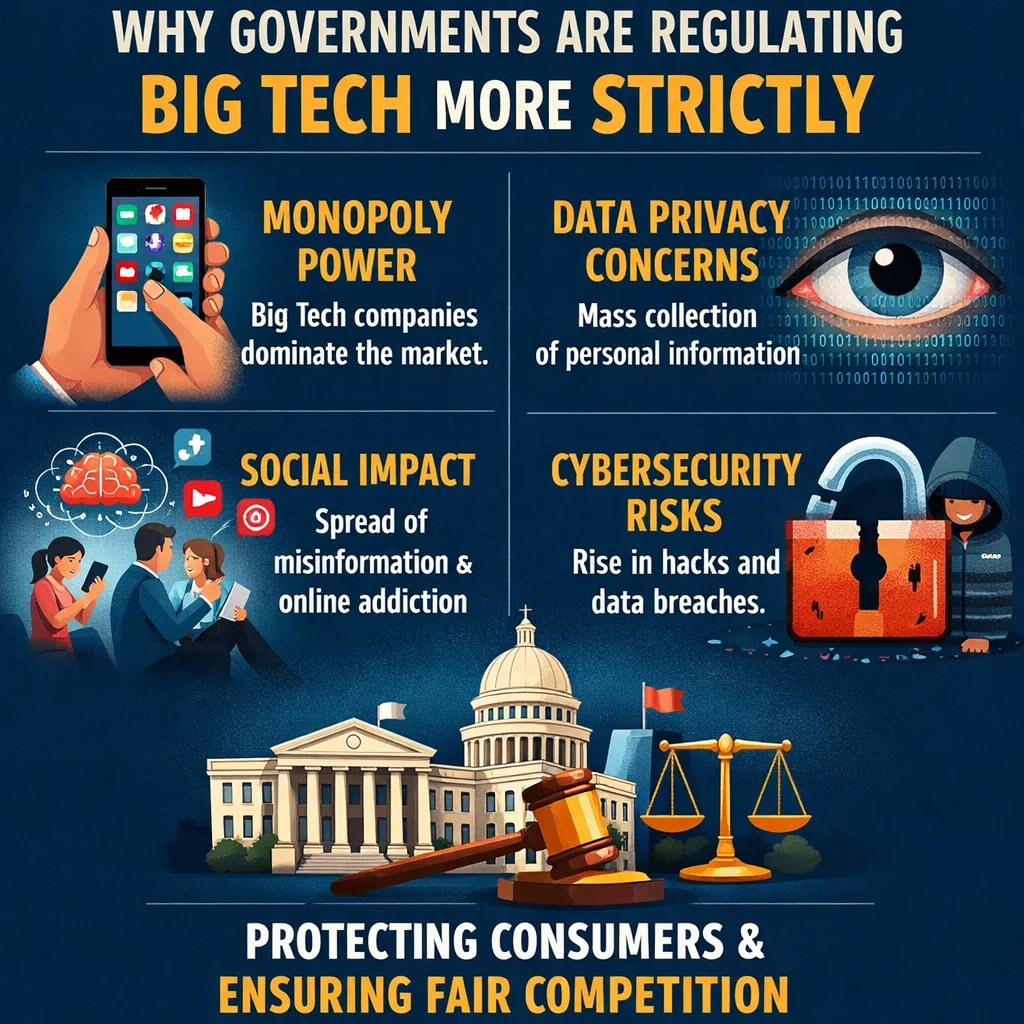
Big tech firms have grown to be some of the most influential organizations in the world throughout the last 20 years. Their platforms influence how people engage in political discourse, communicate, shop, and obtain information. Technology businesses have an impact on almost every facet of contemporary life, from social media networks to cloud services and online marketplaces. Governments all across the world have started enacting more stringent laws to address issues with competitiveness, privacy, data security, and social impact as their influence has increased.
In an effort to strike a balance between innovation and accountability, the discussion around the regulation of large technological companies has been more heated in recent years. The size and power of technology corporations have sparked concerns about market dominance, consumer protection, and democratic governance, even as they have propelled tremendous economic growth and digital revolution.
The Rise of Big Tech Power
In the digital age, technology firms have grown quickly, creating international platforms that link billions of users. These businesses oversee vast data ecosystems, online marketplaces, and communication networks that are now crucial to contemporary economies.
Digital platforms, in contrast to traditional sectors, frequently profit from network effects. A platform's value increases with usage, drawing in additional users and solidifying its place in the market. Because of this dynamic, technological businesses are able to expand rapidly and take over entire industries.
Concerns about whether current regulations were adequate to regulate businesses operating at such size started to surface as their influence grew. Governments began to wonder how to maintain fair competition, safeguard consumer rights, and stop power abuse.
Key Reasons Governments Are Increasing Regulation
Governments have been forced to take more stringent regulatory measures against big digital businesses due to a number of significant issues. Stronger oversight, according to policymakers, is required to guarantee that digital marketplaces continue to be transparent, safe, and equitable.
✔ Increasing market dominance and reduced competition in digital industries
✔ Large-scale collection and monetization of personal user data
✔ Influence of social media platforms on public discourse and elections
✔ Concerns about misinformation, harmful content, and online manipulation
These issues have led regulators to reevaluate how technology companies should be governed in the digital economy.
Data Privacy and Consumer Protection
The growing worry over data privacy is one of the main forces for more stringent regulations. Large volumes of personal data, such as surfing patterns, location information, buying patterns, and social connections, are gathered by technology corporations.
Although this data makes targeted advertising and personalized services possible, it also presents significant privacy issues. The public has demanded more robust consumer safeguards as a result of data breaches, unlawful data sharing, and opaque data practices.
New privacy laws are being introduced by governments, requiring businesses to be more open about the ways in which they gather and utilize personal data. These rules frequently contain stringent standards for data protection, data portability, and user permission.
Key goals of modern privacy regulations include:
✔ Giving users more control over their personal data
✔ Limiting excessive data collection by companies
✔ Ensuring secure storage and handling of sensitive information
✔ Increasing transparency about data usage practices
These measures aim to restore trust between technology companies and their users.
Antitrust Concerns and Market Competition
The problem of market competitiveness is another important area of government control. Opponents contend that big IT firms occasionally abuse their power to stifle competition, buy out up-and-coming competitors, or exert control over online marketplaces.
Several nations' antitrust regulators are looking into whether big tech corporations use tactics that hinder smaller businesses from successfully competing. These tactics could include utilizing enormous amounts of data to obtain unfair advantages, manipulating app distribution networks, or giving their own items priority in search results.
To address these concerns, governments are considering policies such as:
✔ Breaking up monopolistic market structures
✔ Preventing anti-competitive acquisitions of smaller companies
✔ Ensuring fair access to digital platforms and marketplaces
✔ Increasing oversight of algorithm-driven business practices
The goal of these measures is to promote innovation by maintaining a competitive digital marketplace.
The Role of Social Media in Public Discourse
Social media platforms have completely changed how people engage in political discourse and exchange information. Although these platforms facilitate quick communication and worldwide connectedness, they have also taken center stage in discussions over false information and online manipulation.
Governments are increasingly concerned about the spread of false information, coordinated disinformation campaigns, and harmful content that can influence elections or public health decisions.
Holding platforms responsible for the content that is disseminated via their networks is the goal of several proposed regulations. These recommendations frequently center on making content moderation rules more transparent and mandating businesses to take more aggressive measures against offensive content.
Efforts to regulate online platforms often emphasize:
✔ Transparent content moderation policies
✔ Rapid removal of illegal or harmful content
✔ Clear reporting mechanisms for users
✔ Accountability for algorithmic content distribution
These initiatives seek to reduce harm while preserving open online discussions.
The Challenge of Global Technology Platforms
The worldwide reach of large technological businesses makes governing them one of the most difficult tasks. Numerous digital platforms function across dozens or even hundreds of nations, each with its own legal and cultural norms.
This global presence creates challenges for both regulators and companies. Governments may introduce regulations that conflict with policies in other jurisdictions, making compliance complicated.
Common challenges in regulating global tech platforms include:
-
Differences in national privacy laws
-
Conflicting rules about content moderation
-
Cross-border data transfer regulations
-
Enforcement of legal decisions across jurisdictions
As a result, international cooperation is becoming increasingly important in developing consistent approaches to digital governance.
The Role of Artificial Intelligence and Algorithms
To handle massive amounts of data and content, modern technological platforms mostly rely on algorithms and artificial intelligence. These computers identify dangerous content, provide product recommendations, and decide what people see in their feeds.
However, questions of accountability, justice, and openness have been brought up by algorithmic decision-making. Algorithms, according to critics, have the potential to spread false information, perpetuate prejudices, or give preference to content that boosts engagement over veracity.
Governments are therefore beginning to examine how algorithms influence digital ecosystems. Some regulatory proposals focus on improving transparency around automated decision-making systems.
Potential regulatory approaches include:
✔ Requiring companies to explain how algorithms influence content visibility
✔ Auditing AI systems for bias or unfair outcomes
✔ Increasing transparency in recommendation systems
✔ Establishing ethical standards for artificial intelligence
These efforts aim to ensure that technological innovation aligns with societal values.
Balancing Innovation and Regulation
Although many legislators favor stricter regulations, there is also worry that overly stringent regulations may impede the advancement of technology. Communication, healthcare, finance, and education have all seen tremendous progress thanks to technology businesses.
Regulators must therefore find a balance between protecting public interests and allowing innovation to flourish. Effective policies should encourage responsible growth rather than stifle technological progress.
Successful regulatory frameworks often focus on:
✔ Encouraging fair competition in digital markets
✔ Protecting consumer rights and personal data
✔ Promoting transparency in digital platforms
✔ Supporting innovation and entrepreneurship
Finding this balance remains one of the biggest challenges in modern economic policy.
The Future of Big Tech Regulation
Government control over internet platforms will probably grow as technology advances. Artificial intelligence, digital currencies, and immersive virtual worlds are examples of emerging technology that could present new regulatory difficulties.
Future regulatory efforts may focus on:
✔ Governance of AI-driven platforms
✔ Protection of biometric and behavioral data
✔ Regulation of digital marketplaces and app ecosystems
✔ Greater international cooperation in digital policy
The global technology landscape is changing rapidly, and regulatory systems must adapt accordingly.
Conclusion
The increasing awareness that digital platforms have a significant impact on the development of economies, society, and political systems is reflected in the drive for more stringent regulation of large technology corporations. Even though these businesses have greatly benefited society through innovation and networking, their power also calls for responsibility and supervision.
Regulations pertaining to algorithmic transparency, competition, privacy, and disinformation are being implemented by governments more frequently. These initiatives seek to establish a digital environment that safeguards consumers, fosters equitable competition, and supports responsible technical advancement.