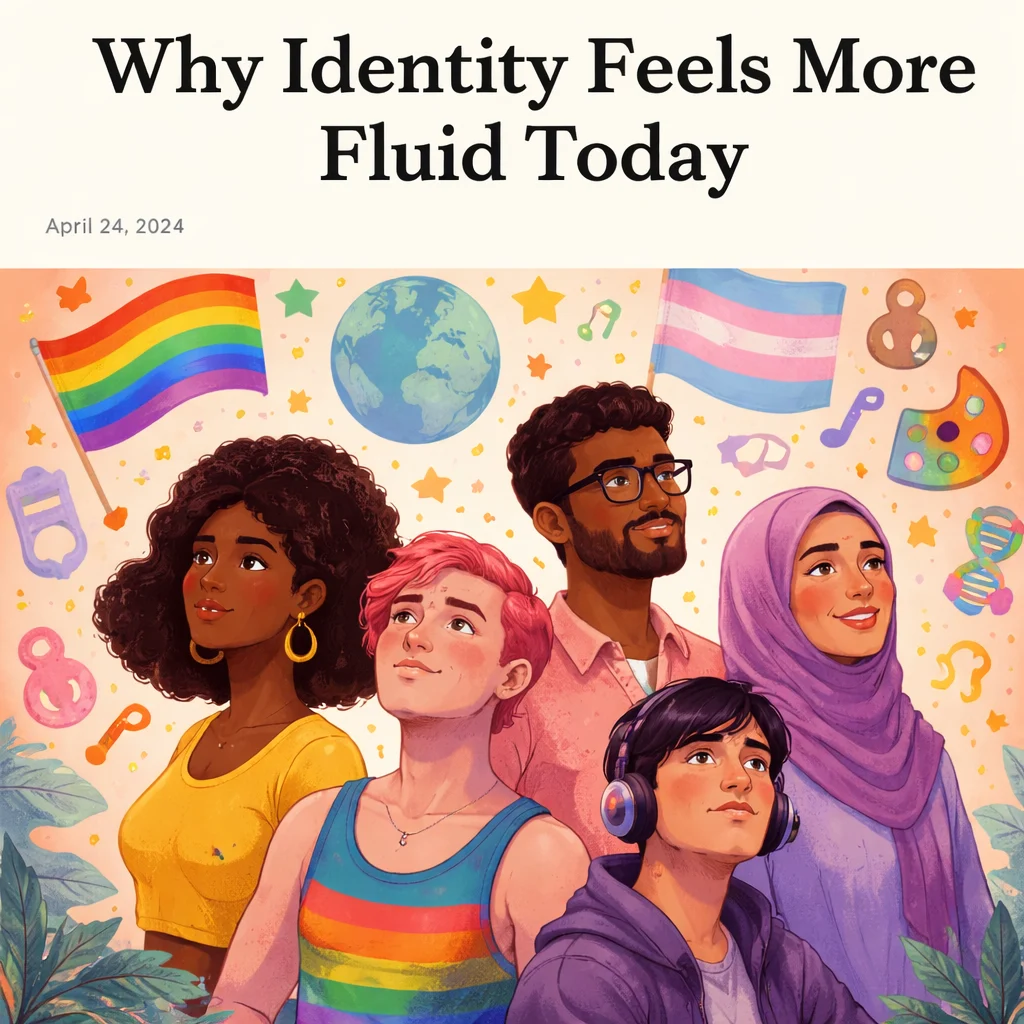
Identity was frequently stable, dependable, and well-defined in previous generations. For the majority of their life, people's identities were shaped by the roles, occupations, communities, cultures, and expectations they were born into. However, identity now seems far more malleable, intricate, and adaptable. More people than ever before are changing occupations, redefining relationships, exploring new values, changing opinions, traveling across cultural boundaries, and experimenting with self-expression. This increasing feeling of fluidity is not coincidental. It reflects profound shifts in culture, psychology, technology, and society.
In addition to explaining how individuals view themselves, an understanding of why identity is more flexible now also explains why ambiguity, exploration, and reinvention have emerged as major themes in contemporary life.
From Fixed Roles to Flexible Lives
In the past, external structures had a significant influence on identity formation. Gender roles, occupation, geography, religion, socioeconomic class, and family history all have a significant impact on an individual's potential. There were few options, and breaking the rules frequently had serious social repercussions.
Many of these restrictions have been relaxed in modern society. Social norms are less strict, mobility is simpler, education is more available, and communication is worldwide. There are now more chances for people to rethink their life, relationships, jobs, and beliefs.
Although this independence opens up possibilities, it also brings with it uncertainty. People must actively create and reconstruct who they are when identity is no longer assigned but rather chosen. Identity feels fluid rather than fixed because of this continuous process.
The Role of Technology in Shaping Identity
Technology has fundamentally changed how individuals express and investigate their identities. People can experiment with several versions of themselves because to social media, digital platforms, online communities, and international contact.
People can display carefully constructed personas online, discover new hobbies, embrace new ideals, and establish cross-border connections with like-minded people. Exposure to a variety of viewpoints broadens the scope of potential identities and lessens the urge to fit in with local standards.
Technology also speeds up change at the same time. Communities change swiftly, trends change quickly, and knowledge spreads instantaneously. The idea that identity is something you continuously adjust rather than something you find once is reinforced by this perpetual movement.
✔ Technology enables identity exploration
✔ Online spaces allow self-expression
✔ Global exposure expands possibilities
✔ Rapid change reinforces fluidity
Cultural Shifts Toward Individual Choice
Authenticity, self-discovery, and personal choice are valued in modern culture. Individuals are urged to "define their own path," "be themselves," and "follow their passion." This cultural narrative is powerful, but it also holds people accountable for constantly assessing and redefining who they are.
People today create their identities by decisions regarding their careers, relationships, lifestyles, ideas, and values rather than receiving pre-made identities. As people develop, learn, and change, these decisions also change. As a result, identity starts to resemble a continuous story rather than a set label.
The Influence of Globalization
People are now exposed to a vast array of cultures, customs, belief systems, and lifestyles because to globalization. Traditional boundaries are blurred by migration, travel, foreign media, and multicultural societies.
Individuals who are raised in multicultural settings frequently combine multiple identities instead of selecting just one. They might experience a sense of belonging to various cultures, languages, customs, and worldviews. This multi-layered identity feels dynamic and adaptable because it does not easily fall into one category.
Rigid notions of nationality, culture, and belonging are also challenged by globalization. Rather than relying solely on geographic or ethnic boundaries, people are increasingly defining themselves via common beliefs, interests, and experiences.
Psychological Development and Identity Over Time
Identity naturally changes with time, as psychology acknowledges. People evolve as they experience new things, overcome obstacles, form connections, and come across novel concepts. What is significant at one point in life could not be at another.
Identity changes were frequently slow and restricted in older societies since life trajectories were more predictable. Identity changes are accelerated in contemporary culture because life paths are more varied and unexpected.
Individuals may reinterpret personal objectives, rethink belief systems, alter family responsibilities, and change occupations several times. Identity feels more like a journey than a destination as a result of this continuous psychological development.
✔ Identity evolves with life experience
✔ Psychological growth reshapes values
✔ Change accelerates in modern society
✔ Identity becomes an ongoing process
The Decline of Traditional Institutions
Stable identity anchors used to come from institutions like religion, extended family, community organizations, and long-term employment. These organizations provided lifetime belonging, defined roles, and common values.
Although these organizations are still in existence, their impact has diminished in many regions of the world. People are less likely to spend their entire lives in one community, one profession, or one set of beliefs. Although it also lessens exterior structure, this erosion of old anchoring promotes individual freedom.
People must find their own sense of purpose, meaning, and belonging in the absence of established institutional positions. Fluidity is a natural result of this self-directed identity creation.
The Impact of Social Comparison
Social comparison is become more intense by social media. People are continuously exposed to the identities, habits, accomplishments, and views of others. This exposure draws attention to different lifestyles that can both stimulate inquiry and lead to discontent.
The sense that identity is malleable and adaptable is strengthened when people witness others changing occupations, redefining relationships, or embracing new ideals. However, comparison can also cause self-doubt, making people wonder if who they are now really represents who they want to be.
This cycle of exposure, comparison, and reevaluation contributes to identity fluidity.
Why Fluid Identity Feels Both Liberating and Unsettling
Freedom results from identity fluidity. Individuals are not restricted to a particular identity; instead, they are free to change, explore, and redefine themselves. This adaptability fosters self-discovery, growth, authenticity, and creativity.
But flexibility also carries with it unpredictability. People may find it difficult to answer questions like "Who am I?" in the absence of clear roles or definitions. "Where should I go?" and "What should I promise to do?" Anxiety, hesitation, and emotional exhaustion may result from this ambiguity.
Learning to negotiate modern identity with stability, self-compassion, and grounded principles is more difficult than the fluidity itself.
The Difference Between Flexibility and Fragmentation
Healthy identity flexibility and harmful identity fragmentation differ significantly. People that are flexible are able to adjust without losing their sense of self. Identity fragmentation happens when it becomes unstable, disjointed, or unduly reliant on approval from others.
Internal values, self-awareness, and emotional continuity serve as the foundation for healthy fluidity. Pressure, comparison, or the need for approval are the main causes of unhealthy fluidity.
✔ Healthy fluidity supports growth
✔ Fragmentation creates instability
✔ Internal values provide continuity
✔ Self-awareness anchors identity
The Role of Emotional Experience in Identity Formation
Identity is influenced by emotional experiences as well as roles and ideas. Long-lasting emotional impressions are left by love, loss, failure, success, tragedy, connection, and joy. People's perceptions of themselves and their values are altered by these encounters.
People are exposed to a greater variety of emotional situations, relationships, and surroundings in modern life. Though it also adds complexity, this emotional diversity increases self-awareness. Identity changes as emotional landscapes do.
Why Authenticity Matters More Than Stability
Stability was frequently prized over authenticity in the past. Even if their roles no longer represented who they were on the inside, people were expected to stay constant. Authenticity is more highly regarded these days. Aligning one's external life with one's inner reality is recommended.
Change is legitimized by this focus on authenticity. People are urged to change rather than stay the same when they outgrow a role, belief, or identity. This promotes psychological integrity while also fostering suppleness.
Identity can evolve without losing consistency when it is authentic. Evolution is guided by its internal compass.
How to Find Stability Within Fluidity
A fluid identity doesn't need to be reinvented all the time. When people ground themselves in fundamental principles rather than rigid roles, stability may coexist with change.
Kindness, honesty, curiosity, compassion, responsibility, and integrity are examples of core values that offer continuity throughout various identities and life phases. As external roles change, these ideals serve as an internal foundation that doesn't change.
✔ Identify core values
✔ Reflect on emotional patterns
✔ Maintain meaningful relationships
✔ Practice self-compassion
These behaviors support the development of a healthy identity while preserving psychological stability.
The Future of Identity
Identity is expected to become even more malleable as technology, cultures, and social systems continue to change. Instead of using rigid classifications, people are increasingly defining themselves by relationships, experiences, values, and purpose.
Although this shift calls into question conventional ideas of self, it also presents a chance to create more inclusive, flexible, and genuine identities.
Conclusion: Identity as a Living Story
Today's world is more fluid, which makes identity feel more fluid. Technology has opened up new opportunities, social institutions have relaxed, cultures have mingled, and individual freedom has grown. As a result, people create identities as dynamic narratives that change over time rather than as static labels.
This flexibility is not a flaw. It reflects human complexity, progress, and adaptation. Instead than going back to strict self-definitions, the goal is to develop compassion, self-awareness, and internal stability in the face of change.
In the end, identity is not something you discover and hold onto forever. Throughout your life, you live, mold, and perfect it.