Introduction
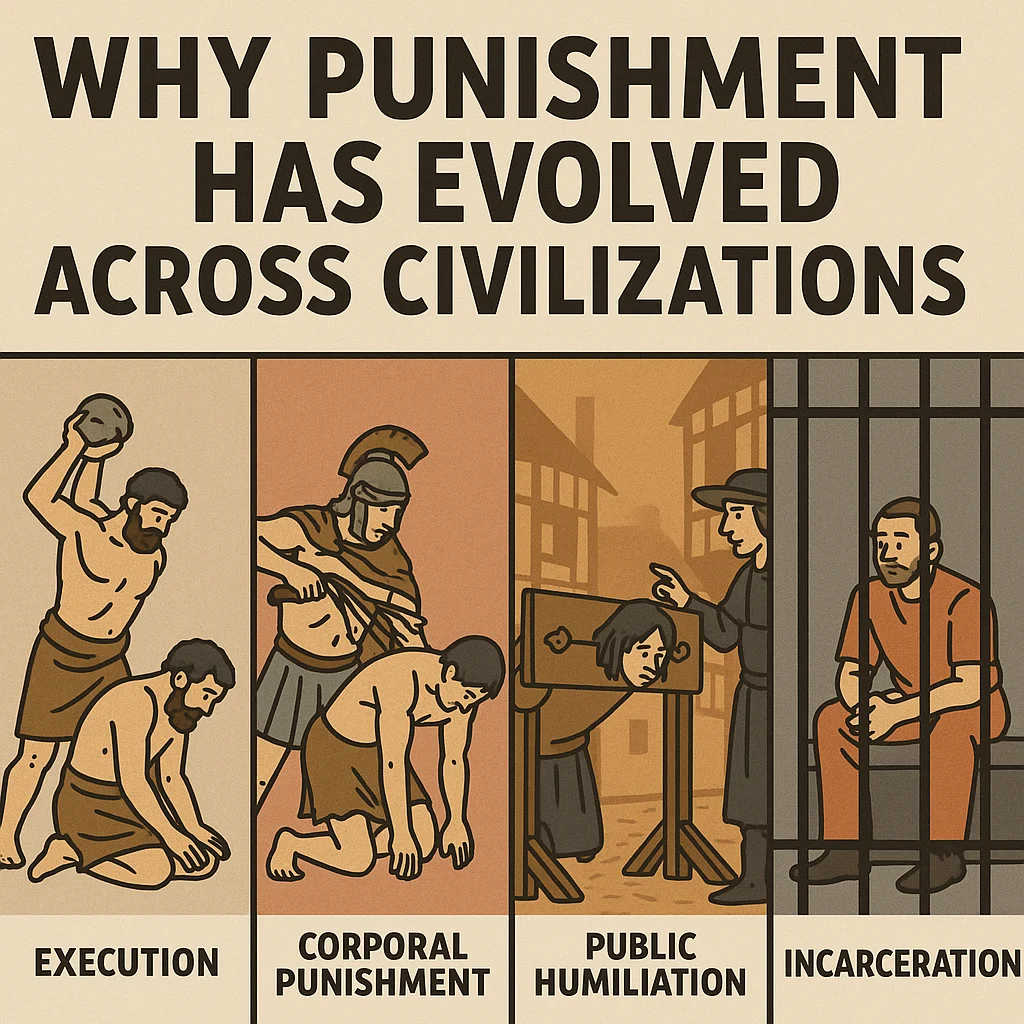
Human history has always included punishment. The concept of holding people accountable for their actions has influenced culture, law, and social order from the first tribal societies to the contemporary legal systems. Punishment, however, has never remained constant. It has changed as philosophies, religions, technologies, and values have changed.
Why did some societies emphasize spiritual penance or rehabilitation while others used harsh public punishments? What can be learned about humanity's conception of morality and justice from these distinctions?
This blog examines how punishment has changed throughout history, demonstrating how it reflects larger changes in power, culture, and the pursuit of justice.
1. The Origins of Punishment: Survival and Deterrence
Punishment was a practical strategy in early human societies. Cooperation and trust were essential in hunter-gatherer societies. Survival may be threatened by food theft, group betrayal, or taboo violations. Frequently, punishment took the following forms:
-
Exile or banishment: Removing threats from the group.
-
Shaming rituals: Reinforcing social norms by humiliating offenders.
-
Physical retribution: Ensuring immediate deterrence.
These punishments were not necessarily about moral judgment but about keeping the group safe.
2. Punishment in Ancient Civilizations
Punishment became more standardized and structured as civilizations expanded.
Hammurabi’s Code (Babylon, ~1750 BCE)
Retribution was emphasized in Hammurabi's Code, one of the first written legal systems: "an eye for an eye, a tooth for a tooth." The proportionality principle sought to create predictable justice and avoid excessive retaliation.
Ancient Egypt
In Egypt, the concept of Ma'at, or cosmic balance and order, was linked to punishment. Punishments, such as beatings, mutilations, or forced labor, were considered necessary to restore universal order because crimes disturbed harmony.
Ancient China
Punishment was closely linked to hierarchy in early dynasties. The purpose of harsh physical punishments like branding or flogging was to engender obedience. However, the strictness of earlier codes was tempered by Confucian philosophy, which later placed a strong emphasis on moral education and correction.
Ancient Greece
Philosophy and democracy both impacted Greek punishment. Philosophers like Plato promoted rehabilitative justice, seeing punishment as a means of "curing" the wrongdoer, while citizens faced fines, exile, or execution.
Ancient Rome
Rome balanced retribution with spectacle. Punishments like crucifixion, gladiatorial execution, and public torture reinforced state authority. Yet Rome also pioneered legal protections, such as the right to trial, foreshadowing modern justice systems.
3. The Role of Religion in Shaping Punishment
Religion has been one of the strongest influences on how societies understood and applied punishment.
-
Hinduism: According to Karma, sin was a cosmic imbalance, and punishment was linked to spiritual repercussions that persisted throughout a person's lifetime.
-
Judaism: The Torah stressed mercy and reparation in addition to prescribing penalties.
-
Christianity: Although forgiveness was emphasized in early Christian teachings, medieval Europe frequently combined religion and law, which resulted in severe penalties like heresy executions and inquisitions.
Religion often framed punishment as not just social but divine—wrongdoing offended both community and gods.
4. Medieval Punishments: Fear as Social Control
In order to create fear, the Middle Ages were characterized by severe and visible penalties.
-
Torture: Used to extract confessions and intimidate.
-
Public executions: Hanged, drawn, and quartered criminals served as grim theater.
-
Shaming devices: Stocks, pillories, or branding humiliated offenders, reinforcing social order.
These penalties were a reflection of societies in which justice was more about deterrence than rehabilitation and rulers used fear to gain control.
5. The Birth of Modern Legal Thought
Concepts of punishment were altered during the Enlightenment (17th–18th centuries). Philosophers stressed rational justice and questioned cruelty.
-
Cesare Beccaria (Italy, 1764):He opposed the death penalty and torture in On Crimes and Punishments, arguing that swift, proportionate punishments would serve as better deterrents.
-
Jeremy Bentham (England, 18th century): promoted utilitarian justice, which holds that punishment should do more than just cause suffering.
-
Prisons: started to take the place of torture and executions as the most common form of punishment, indicating a move toward order and reform.
This era marked the turning point from punishment as vengeance to punishment as a tool for social improvement.
6. Punishment in the Industrial Age
Punishment changed in tandem with industrialization and urbanization during the 19th and early 20th centuries.
-
Prisons expanded: Designed to rehabilitate but often overcrowded and brutal.
-
Labor-based punishments: Penal colonies and hard labor reflected industrial values of productivity.
-
Juvenile justice: Reform schools emerged as a result of the realization that children needed different treatment.
Punishment increasingly reflected economic systems—discipline, work, and productivity became central themes.
7. The 20th Century: From Retribution to Rehabilitation
Two world wars, human rights movements, and globalization reshaped punishment again.
-
Abolition of torture and executions: As humanitarian values grew, many countries abolished the death penalty.
-
Psychological approaches: Rehabilitative models emerged as criminology started looking at the social, economic, and mental health aspects of crime.
-
Restorative justice: This model, which first appeared in the latter half of the 20th century, centered on mending damage via communication between victims and perpetrators.
Punishment shifted from sheer retribution toward prevention, correction, and social healing.
8. Punishment Today: A Global Spectrum
In the 21st century, punishment varies dramatically across cultures.
-
Scandinavian model: Humane prisons that prioritize reintegration are found in nations like Norway, which place a strong emphasis on rehabilitation.
-
U.S. system: Still heavily punitive, with mass incarceration reflecting social inequalities.
-
Authoritarian regimes: Use incarceration, censorship, or even executions as a form of political control.
-
International law: The International Criminal Court and war crimes tribunals represent a global endeavor to hold people accountable across national boundaries.
Punishment now reflects cultural, political, and economic differences as much as universal human ideals.
9. Why Punishment Keeps Evolving
Punishment evolves because societies evolve. Each shift reflects deeper changes in what people value:
-
From survival to morality: Early punishments protected groups; later ones enforced moral codes.
-
From fear to fairness: While modern systems emphasize equality and fairness, medieval punishments were based on fear.
-
From retribution to restoration: Many societies today view punishment as a chance for healing rather than retaliation.
-
From local to global: Because of international law, punishment now transcends national boundaries and reflects universal human values.
Punishment, then, is less about crime alone and more about how societies imagine justice, morality, and humanity.
10. The Future of Punishment
Looking ahead, punishment may continue to evolve in surprising ways:
-
Restorative and transformative justice could replace punitive systems, focusing on healing communities.
-
Technology-based punishments (like digital monitoring or AI sentencing) could raise ethical concerns.
-
Climate and resource crimes may become central to global justice, as environmental harm affects humanity collectively.
-
Global justice systems could grow stronger, holding individuals accountable for crimes against humanity regardless of borders.
The way that punishment has changed over time will continue to mirror humanity's quest for harmony among responsibility, equity, and compassion.
Conclusion
Punishment has always reflected the values of the societies that impose it, from exile in prehistoric tribes to AI-driven surveillance. It started out as a survival issue, developed into a moral and religious obligation, and then evolved into a science of law and psychology. Punishment has changed over time to define justice itself as well as to discourage crime.
Whether we view people as flawed beings capable of growth and restoration or as irredeemable wrongdoers, our approach to punishment ultimately reflects our beliefs about human nature. Therefore, the development of punishment is actually the development of human moral imagination.