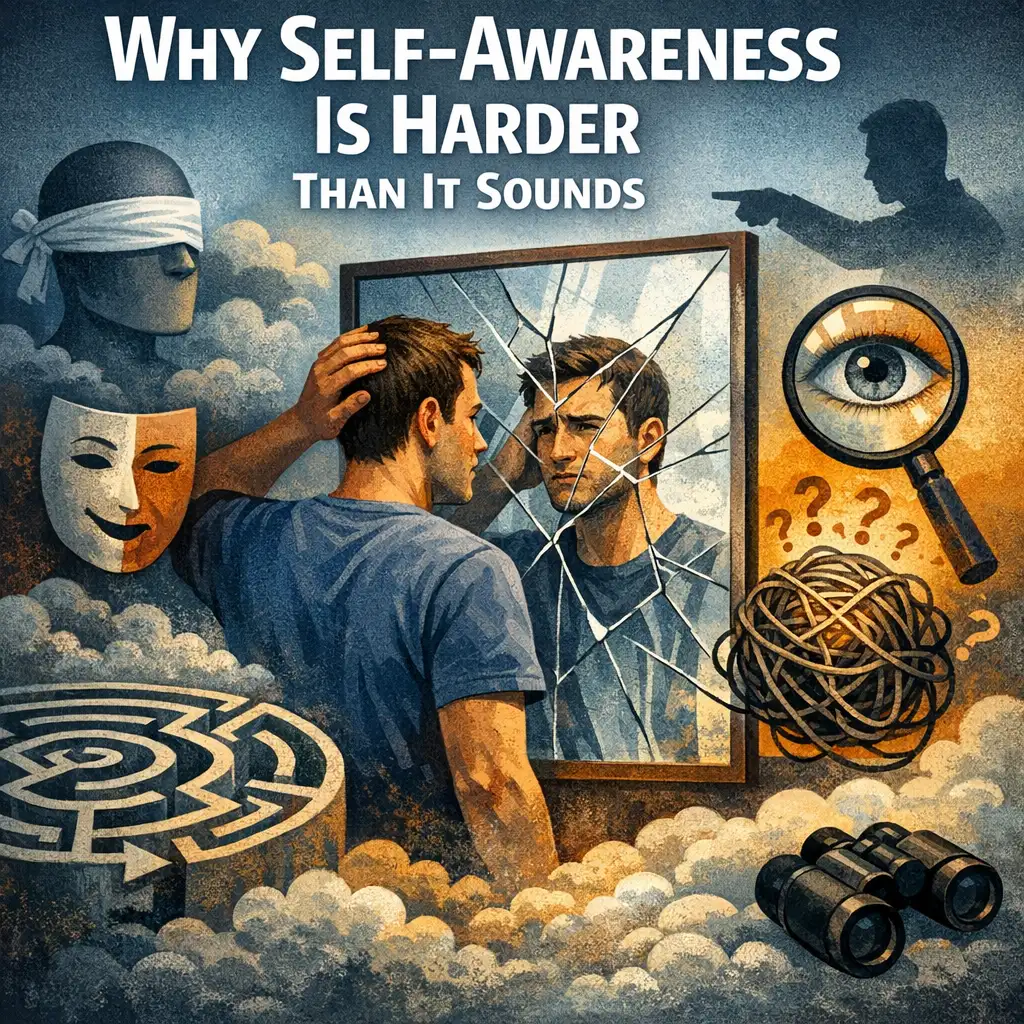
One of those traits that everyone discusses but few people actually grasp is self-awareness. We are informed that self-awareness promotes emotional equilibrium, healthier relationships, and better decision-making. We are continually urged to "look inward" and "know who we are" by books, podcasts, and inspirational sayings. However, true self-awareness is still shockingly uncommon despite all of this encouragement. Although study and actual conduct frequently indicate otherwise, many people think they are self-aware.
We are both the observed and the observer, which is a straightforward fact that presents a challenge. It's like attempting to view your own eyes without a mirror when you try to understand yourself objectively. Blind spots, emotional defenses, and deeply rooted behaviors that skew our self-perception are all part of the process. Being self-aware involves facing difficult realities that we frequently spend years avoiding. It goes beyond simply being aware of our thoughts and feelings.
What Self-Awareness Really Means
Being self-aware involves more than just being aware of your skills, job aspirations, and favorite color. On a deeper level, it entails being aware of your feelings, motives, prejudices, habits, and how you affect other people. It is the capacity to understand the reasons behind your actions rather than just the fact that you reacted.
There are two key components to true self-awareness. One is internal self-awareness, which is the degree to which you comprehend your own inner world, including your emotional triggers, anxieties, desires, and ideals. The other is external self-awareness, which is being aware of how other people see you. The majority of people have a strong preference for one while ignoring the other, giving an inaccurate impression of their true selves.
The Illusion of Self-Knowledge
The human brain is remarkably adept at telling compelling stories, which is one reason self-awareness is more difficult than it seems. We continually justify our actions to ourselves, frequently in ways that uphold our perception of ourselves rather than accurately represent reality. Even when these explanations are false, they nonetheless seem plausible.
This is known as self-serving bias by psychologists. We frequently give ourselves credit for accomplishments and place the blame for setbacks on outside forces. These stories develop into identities throughout time. Once an identity is established, it is intimidating to challenge it. Consequently, self-awareness becomes less about self-discovery and more about self-defense.
✔ We overestimate how rational our decisions are
✔ We undervalue the impact that emotions have on our actions.
✔ We confuse intentions with actual impact
✔ We think we know ourselves better than we actually do.
Growth is hampered by this delusion of self-knowledge since you can't alter what you can't perceive.
Emotional Discomfort and Avoidance
Sitting with painful feelings like guilt, shame, anxiety, insecurity, or regret is frequently necessary for self-awareness. The mind naturally seeks to prevent suffering. We divert our attention with job, amusement, or continuous stimulus rather than analyzing these emotions. Avoidance is simple in today's world, which subtly erodes self-awareness.
Our defenses automatically kick in when something contradicts our perception of ourselves. We rationalize, reduce, assign blame, or justify. In the short term, these responses safeguard our emotional comfort, but they obstruct long-term comprehension. In order to be truly self-aware, we must endure discomfort long enough to draw lessons from it.
Cognitive Biases That Distort Self-Perception
Our brains use shortcuts to make sense of the world, yet self-awareness is frequently distorted by these shortcuts. Confirmation bias causes us to look for data that confirms our preconceived notions about who we are. People who are more self-aware tend to doubt themselves, whereas those who are less self-aware tend to overestimate their comprehension due to the Dunning-Kruger effect.
These prejudices function covertly. Self-awareness is deceptively straightforward in principle but complicated in practice since we hardly ever see them in action.
✔ We notice flaws in others more easily than in ourselves
✔ We misjudge our emotional reactions after the fact
✔ We rewrite memories to fit our current identity
It takes deliberate effort and humility—qualities that most people lack—to overcome these prejudices.
The Role of Ego and Identity
Because it keeps our sense of self steady, ego is not intrinsically harmful. It also rejects information that jeopardizes such stability, though. When self-awareness highlights discrepancies between our perceived identities and our real behaviors, it can feel like an assault on identity.
For instance, a person who considers themselves to be nice could find it difficult to admit when they have been selfish. A person who prioritizes independence could overlook how much they depend on approval from others. It is the ego's responsibility to maintain coherence rather than correctness. Because it upends established narratives, honest self-reflection can be unsettling.
Why Feedback Feels So Hard to Accept
Although it is one of the most effective methods for increasing self-awareness, external input is also one of the most resisted. Even when the criticism is well-meaning, hearing what other people think of us can make us defensive. Feedback that challenges our internal self-image causes us to react in this way.
Impact and intent are frequently at odds. While people evaluate us based on our deeds, we evaluate ourselves based on our intentions. It takes time to develop emotional maturity and openness in order to bridge this gap.
✔ Our self-story is challenged by feedback.
✔ It reveals blind spots that we are unable to see on our own.
✔ It compels us to balance impact and aim.
Self-awareness is not complete without feedback. Growth is made possible by it.
Self-Reflection Isn’t Automatic
A common misconception is that self-reflection equates to self-awareness. In actuality, not all introspection is beneficial. Repeating unfavorable ideas without gaining insight is known as rumination, and it frequently causes anxiety without enhancing comprehension. Honesty, curiosity, and organized introspection are necessary for productive self-awareness.
Inquiries such as "Why did I react that way?" or "What belief is driving this behavior?" are more helpful than "What's wrong with me." More important than quantity is the quality of reflection.
The Influence of Social Conditioning
We are influenced by social roles, cultural standards, and family expectations from an early age. These effects get absorbed over time, making it challenging to discern between our true selves and the people we were taught to be. Many adults never challenge their inherited ideas.
Examining these presumptions and determining which ones are consistent with your true values is a key component of self-awareness. This process might be unsettling, particularly if your identity has been constructed around approval from others.
Why Self-Awareness Takes Time
Self-awareness does not develop linearly, in contrast to technical skills. It grows from reflection, experience, and mistakes. Because they upend routines and compel reflection, significant life experiences like failure, loss, conflict, or change frequently hasten self-awareness.
✔ Experience, not quick fixes, is how self-awareness develops.
✔ With time and introspection, emotional maturity deepens.
✔ As obstacles in life mount, awareness grows.
There is no ultimate point at which a person becomes "fully self-aware." It is a continuous process that changes as conditions and viewpoints do.
Practical Ways to Develop Deeper Self-Awareness
Self-awareness is a challenging but attainable goal. It can be steadily sharpened by small, regular practices.
Finding underlying beliefs is made easier by paying attention to emotional triggers. Recurring behaviors can be seen by looking for patterns in relationships. Journaling can reveal hidden presumptions and slow down thought processes. Clearer observation is made possible by the space that mindfulness generates between emotion and reaction.
Above all, self-awareness is sustainable when it is approached with curiosity rather than condemnation. Compassion, not self-criticism, is what fosters growth.
Conclusion
Because it goes against our tendencies for security, comfort, and self-defense, self-awareness is more difficult than it seems. Our brains are programmed to protect our identities, steer clear of unpleasantness, and simplify the world. To be truly self-aware, you must have the guts to challenge your narratives, pay attention to criticism, and confront difficult realities head-on.
Nevertheless, developing self-awareness is one of the most fulfilling abilities, despite its challenges. Relationships are strengthened, decision-making is enhanced, and there is a greater sense of connection between one's identity and lifestyle. Although the inward trip might be difficult, it is also the starting point for long-term development.