The culture in which we live exalts speed. We celebrate multitasking, exalt busyness, and take pride in being exhausted. We're told that every second counts. We strive to meet deadlines, gauge our progress by how quickly we can complete them, and occupy every downtime with new work.
However, we have mistaken motion for progress at some point.
We frequently lose sight of our direction in our fixation with acceleration. We move quickly, but we lose sight of our motivation.
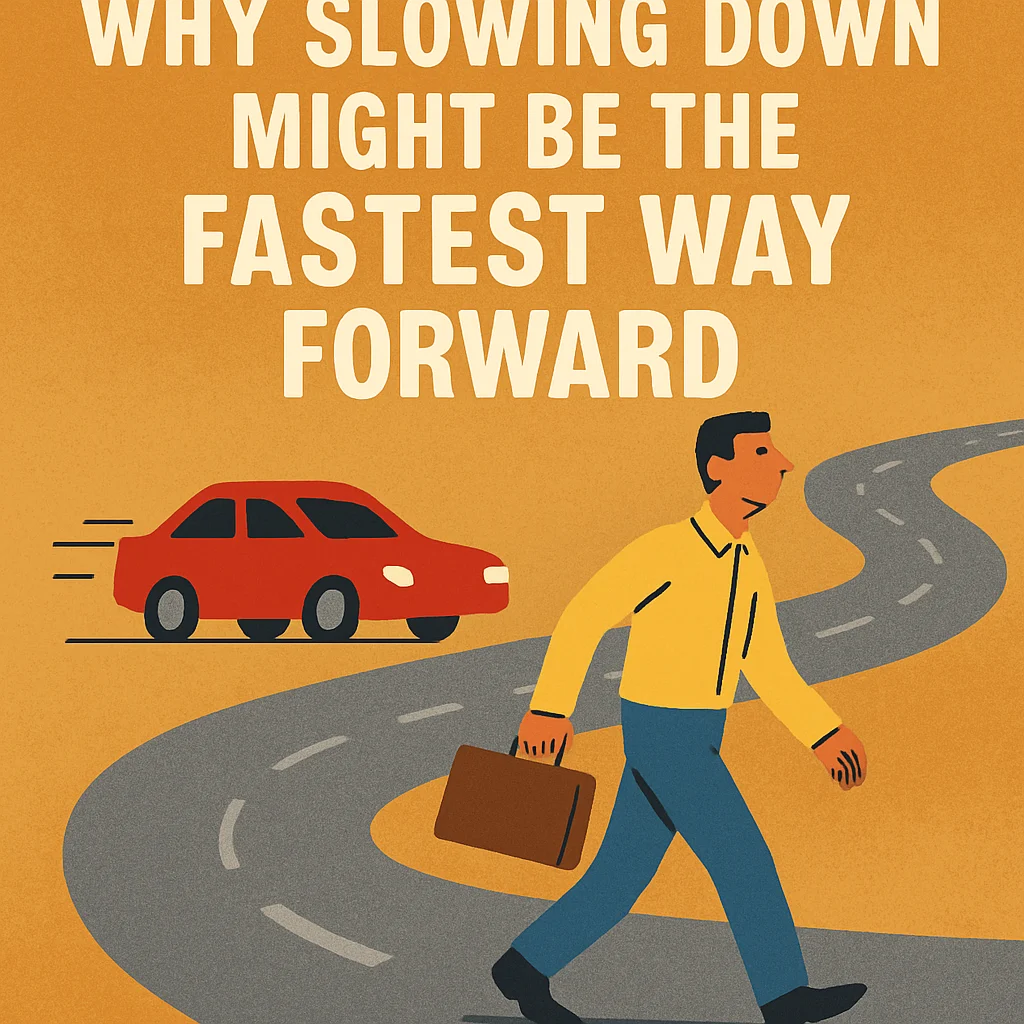
The truth is paradoxical yet timeless: sometimes, the fastest way forward is to slow down.
Slowing down allows for depth, creativity, and clarity—all of which are necessary for real progress. This is about doing better, with awareness and purpose, not about doing less for the sake of being lazy.
Let’s explore why slowing down may be the most powerful form of progress in a world that never stops running.
1. The Myth of Constant Speed
We are indoctrinated to think that speed is superior and that the fastest person wins the race. It's the reasoning behind the "rise and grind" mentality, hustle culture, and the never-ending supply of productivity tips.
However, people are not machines. We are emotional beings who are cyclical and profoundly impacted by energy rhythms.
Burnout eventually results from constant speed, and stagnation is the result of burnout.
Consider this: an automobile that is driven at maximum speed for an extended period of time will overheat. The same holds true for your creativity, body, and mind. Living in overdrive has a biological and psychological cost, which frequently shows up as weariness, stress, and alienation.
Ironically, you tend to accomplish more when you slow down—not because you're doing more, but rather because you're doing the right things with intention and focus.
2. Slowness Brings Clarity
Your vision becomes blurry when life seems to be a blur. Instead of making thoughtful decisions, you make impulsive ones. You mistake importance for urgency.
Slowing down is how you regain perspective. It gives you the space to ask essential questions:
-
Am I moving toward something meaningful, or just moving to avoid stillness?
-
What do I actually want, beyond the next goal or milestone?
You can see patterns and truths that speed hides when you are still. You can identify your true motivations during this pause, including whether you are acting out of genuine purpose, fear, or pressure.
Without reflection, you risk building a fast life that leads nowhere. With reflection, even small steps move you in the right direction.
3. Depth Over Volume
We frequently use numbers to gauge success, such as the number of projects completed, accomplishments made, and hours put in. But what makes life meaningful is depth, not volume.
You allow yourself to go deeply when you slow down. to devote enough time to one thing in order to comprehend, hone, and master it. Real innovation and excellence take place here.
Consider writers, scientists, or artists whose best work resulted from immersion rather than speed.
Incubation, the process by which concepts develop, revelations emerge, and connections are made beneath the surface, is made possible by slowness.
Fast progress might bring quick results, but slow progress builds lasting impact.
4. The Science of Slow Thinking
Psychologist Daniel Kahneman, in his book Thinking, Fast and Slow, described two modes of thought:
-
System 1: Fast, intuitive, and reactive.
-
System 2: Slow, deliberate, and analytical.
We require both, but System 1 thinking—fast decisions, immediate reactions, and quick execution—is highly rewarded in our society. True wisdom and strategic thinking, on the other hand, reside in System 2, which is a slower, more contemplative process that calls for patience and time.
You make fewer mistakes when you give yourself permission to think slowly. You notice subtleties. You are aware of complexity. You base your decisions on knowledge rather than hunches.
Slowing down doesn’t mean inefficiency — it means smarter, more sustainable thinking.
5. Slowing Down Restores Creativity
Constant pressure does not foster creativity. It grows during times of play, curiosity, and relaxation.
That’s why so many great ideas come in the shower, during walks, or while doing nothing at all.
Your brain goes into a relaxed awareness state when you slow down, which is where your imagination comes to life. This mental state, which is triggered when we daydream or allow our thoughts to wander, is known to neuroscientists as the default mode network.
This is not laziness; it’s mental restoration. Without it, creativity starves.
Therefore, if you're having trouble coming up with ideas, it might be better to take a break, unplug, and allow your mind to wander rather than trying harder.
6. Slowness Strengthens Presence
Speed pulls you away from the present. You're constantly looking forward to the next assignment, email, or accomplishment. Instead of being an experience, life turns into a checklist.
But slowing down anchors you in now — the only place life actually happens.
When you eat slowly, you taste.
When you walk slowly, you notice.
When you listen slowly, you understand.
Ordinary moments become meaningful when one is present. It substitutes thankfulness for anxiety. It helps you rediscover the richness of life, which speed has a way of flattening.
Presence isn’t inefficiency; it’s awareness turned into wisdom.
7. The Slow Approach to Growth
Rapid success frequently carries a hidden fragility. Overnight-growing businesses can fail just as fast. Instant gratification-based relationships frequently end. Hurried personal change rarely lasts.
Slowness, however, builds resilience.
You deeply integrate lessons when you take the time to grow. You gain endurance, flexibility, and patience—qualities that support sustained advancement.
The oak tree grows slower than the weed, but it stands for centuries.
Growth that lasts always takes time.
This applies to habits, careers, creativity, and even healing. You can’t rush transformation. It ripens only through consistent, patient effort.
8. Slowing Down in a Digital World
With constant notifications, round-the-clock connectivity, and the sense that everything must happen instantly, our digital lives are made to keep us moving quickly. However, this speed has a price: emotional weariness and divided attention.
Slowing down in the digital age is an act of rebellion — and self-preservation.
It might mean:
-
Setting screen-free hours.
-
Taking intentional breaks.
-
Choosing long-form reading over scrolling.
-
Saying no to the constant pressure to be “on.”
By reclaiming your attention, you reclaim your life. You begin to live by rhythm instead of reaction. And in doing so, you rediscover what real time feels like.
9. The Courage to Move Slowly
It takes guts to move slowly in a society that rewards quick thinkers. You run the risk of coming across as unambitious or lagging. However, being slow doesn't mean doing nothing; rather, it means giving your all to the things that are important.
It’s easy to chase the next thing. It’s harder — and braver — to sit still long enough to know what truly matters.
The fastest path forward is not the one that moves quickest, but the one that moves wisely.
Being slow shows that you have more faith in your timing, your method, and your instincts than in other people.
10. Finding Your Own Pace
Slowing down is about aligning ambition, not rejecting it. There will be times when things move more quickly and times when nothing moves. Knowing which one you're in is where the wisdom is.
Sometimes it's essential to move quickly in order to take advantage of opportunities or get past inertia. You can't steer, though, if you never slow down.
Learning to switch between doing and being, between exertion and relaxation, is essential to determining your own pace. It entails planning a life that prioritizes rhythm over hurriedness.
When you move at your own pace, you stop competing and start living.
Conclusion: Slow Is Smooth, Smooth Is Fast
The military has a proverb that goes, "Slow is smooth, and smooth is fast." The idea is straightforward: you actually make fewer mistakes and achieve more in the long run when you slow down enough to move intentionally.
The same applies to life.
You behave with grace, clarity, and purpose when you take your time. You start going in the right direction and quit running in circles.
It may seem counterintuitive, even radical, to slow down in a society that is fixated on speed. However, slowing down helps you regain equilibrium, find focus, and re-establish a connection with life's deeper rhythm.
Because in the end, the real race isn’t about who finishes first.
It’s about who arrives fully alive.