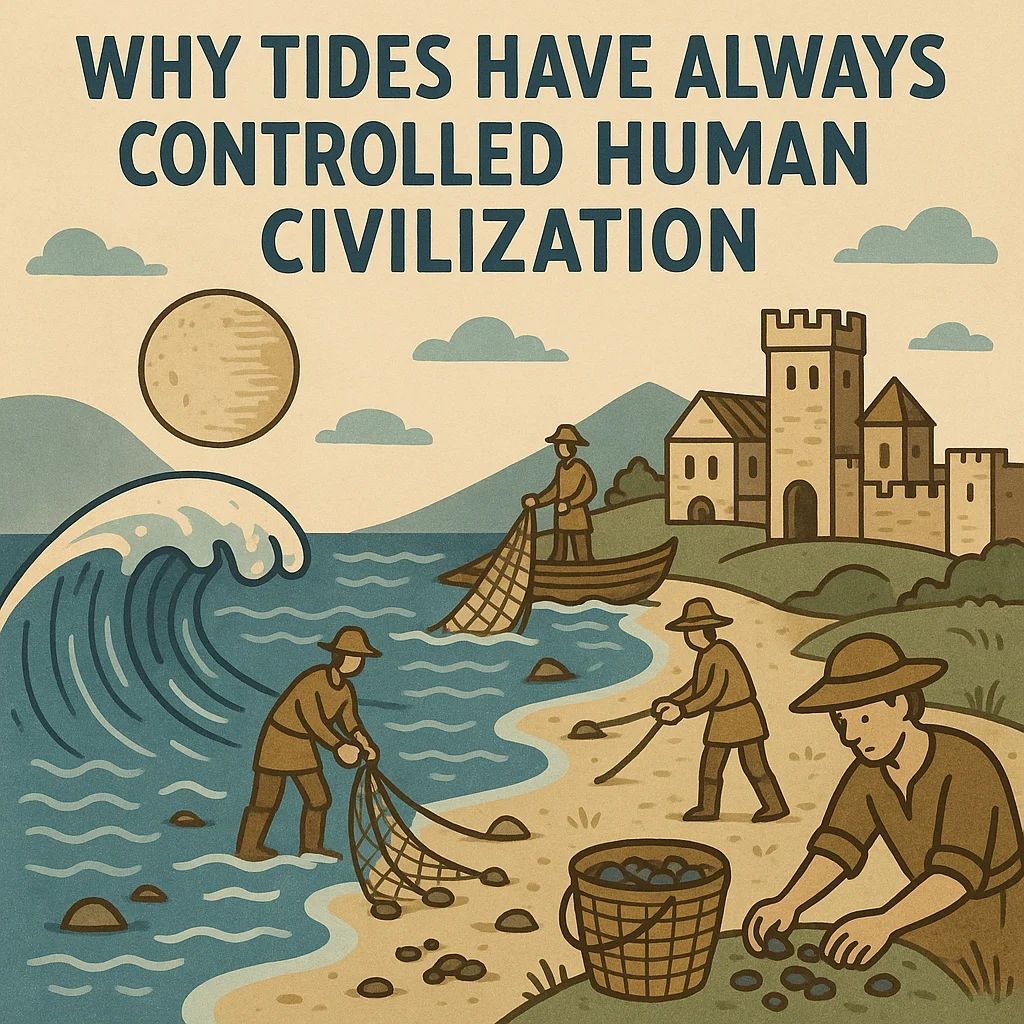
From the first human settlements to the state-of-the-art science of today, tides have influenced how civilizations grow, prosper, and even dream. Although the sea's daily rises and falls may seem insignificant to us today, tides were once strong forces that influenced trade, agriculture, spirituality, survival, and even the beginning of science. To comprehend tides is to comprehend how people have always been bound by the cycles of nature.
The Primordial Relationship Between Tides and Humanity
Early communities established themselves along river mouths and coastlines long before people learned to write. These decisions were not made by accident; early societies were influenced by the food, fertile soil, and organic movement patterns that the tides provided.
-
Fisheries and Food Security: Fish and shellfish found steady and convenient food sources in the tidal pools that were left over after the sea receded.
-
Navigation Clues: Prior to the invention of compasses, sailors relied on dependable tidal patterns to determine when it would be safe to set sail or when the sea would be calm enough to travel.
-
Settlement Placement: Early settlements frequently appeared where rich soil was deposited by tidal changes, which facilitated crop cultivation.
In this sense, tides weren’t merely background events—they dictated where humans lived and how they survived.
Tides and Agriculture: The Birth of Coastal Farming
Early agriculture was one of the most important—yet least remembered—applications of tides. In tidal floodplains, crops are naturally fertilized by the nutrient-rich silt that is brought in by the water's rise and fall.
-
Mesopotamia and the Fertile Crescent: Tidal influences close to the Persian Gulf also enhanced the land, allowing farming surpluses that drove the earliest civilizations, even though rivers like the Tigris and Euphrates are frequently praised.
-
China’s Ancient Paddy Fields: Along the Yangtze Delta, some of the first rice farmers irrigated their crops using tidal wetlands.
-
European Salt Marsh Farming: Communities in medieval Europe used the tides to control fertile fields after reclaiming tidal marshes for agriculture.
The rhythm of tides helped transform humanity from nomadic hunter-gatherers to organized, agricultural societies.
Tides as the First Clocks of Civilization
Prior to the development of mechanical clocks, human timekeeping was done by natural cycles. The tides were the first "short clocks" that humans used, much like the sun and moon offered more comprehensive time measures.
Coastal communities relied on tides to regulate their daily schedules:
-
Fishermen set out at low tide and returned at high tide.
-
Salt harvesters collected mineral deposits when the tide receded.
-
Traders waited for favorable tides to dock their ships at shallow ports.
The predictability of tides gave ancient societies their first taste of reliable, natural scheduling.
The Maritime Revolution: Tides and Global Trade
The tides became the invisible hand directing international trade as civilizations became more interconnected. Tidal windows allowed ships carrying precious metals, silk, and spices to enter and exit harbors safely.
-
The British Empire: Britain's proficiency with tidal navigation was a major factor in its naval supremacy. By using tidal knowledge to schedule international trade, British ports such as London and Liverpool developed into major cities.
-
Indian Ocean Trade Routes: By mastering the tidal currents along the East African coast, Arab traders were able to coordinate their trade with the monsoon winds and the tides.
-
The Age of Exploration: In addition to being fearless explorers, Vasco da Gama and Magellan were also skilled navigators who were acutely aware of the tides. It would not have been possible to expand globally without an understanding of tidal forces.
Tides literally expanded the reach of humanity, turning coastal towns into bustling hubs of cultural exchange.
Tides and the Birth of Science
Early scientific discoveries were also sparked by humanity's fascination with tides. For centuries, people believed that tides were mystical and mysterious. Greek philosophers of antiquity argued over whether the gods' influence or the "breathing of the Earth" was to blame.
Only in the 17th century did Isaac Newton demonstrate how gravitational pull explains the rise and fall of water, confirming the actual connection between the Moon and tides. This realization established the foundation for contemporary physics and astronomy in addition to solving a natural conundrum.
The arguments between Galileo, Kepler, and Newton regarding tides advanced science's comprehension of the cosmos. To put it briefly, tides influenced human thought in addition to human society.
Spiritual and Mythological Dimensions of Tides
Beyond science, tides also held deep spiritual significance. Ancient cultures saw tides as sacred expressions of divine power.
-
Hindu Beliefs: The Moon (Chandra) was associated with the tides and was regarded as vital to fertility and life in Vedic traditions.
-
Norse Mythology: The sea's steady rise and fall, which represented chaos and balance, was connected to the gods' never-ending conflict.
-
Pacific Island Cultures: In order to navigate over great expanses of ocean, Polynesian navigators regarded tides as gifts from the ocean gods.
For many, tides weren’t just physical events—they were messages from the cosmos.
Modern Civilization: Still Ruled by Tides
Although it might appear that tides no longer control our day-to-day activities, they actually continue to be significant forces in contemporary society.
-
Ports and Shipping: Global shipping schedules are still determined by tidal charts, despite the use of GPS and enormous cargo ships.
-
Energy Production: One of the most promising renewable energy sources is tidal power, which produces electricity by harnessing the tides' predictable rise and fall.
-
Coastal Cities: When designing flood defenses and infrastructure, urban planners in Shanghai, Mumbai, and New York still have to take tides into consideration.
Despite our technology, humanity remains tethered to tidal rhythms—just as our ancestors were.
The Psychological Pull of the Tides
Why do tides still captivate people? In addition to their practical applications, tides have long been used as a metaphor for human existence. Their never-ending ascent and descent represent cycles of adversity and rebirth, hope and despair. The tides have been viewed as reflections of the human soul by writers, poets, and philosophers throughout history.
This psychological link explains why millions of people still find tranquility while strolling along the shore and observing the tides. The tides serve as a constant reminder that life is a never-ending cycle of change, regardless of our best efforts to maintain stability.
Tides as Humanity’s Silent Partner
Looking back, it's amazing to see how tides, which seem so commonplace today, have been a silent companion throughout human history. Where we built our cities, how we ate, when we traveled, what we worshipped, and even how we started to comprehend the universe were all influenced by them.
The tale of tides is inextricably linked to the tale of civilization. As our species progressed from coastal foragers to world explorers, they served as the unseen metronome of history.
Conclusion: Living in Rhythm with the Tides
In a world that frequently seems to be controlled by human ingenuity, tides serve as a reminder that the forces of nature are still more resilient than our technological advancements. They have shaped our lives, development, and relationships for thousands of years.
Humanity will always be dependent on Earth's cycles—its sun, moon, and most importantly, its tides—even as we discuss space travel and the colonization of other planets.
Comprehending this profound connection is a lesson in humility as well as an act of historical curiosity. Humanity needs to adapt to the changing tides in order to survive, as evidenced by civilization itself.