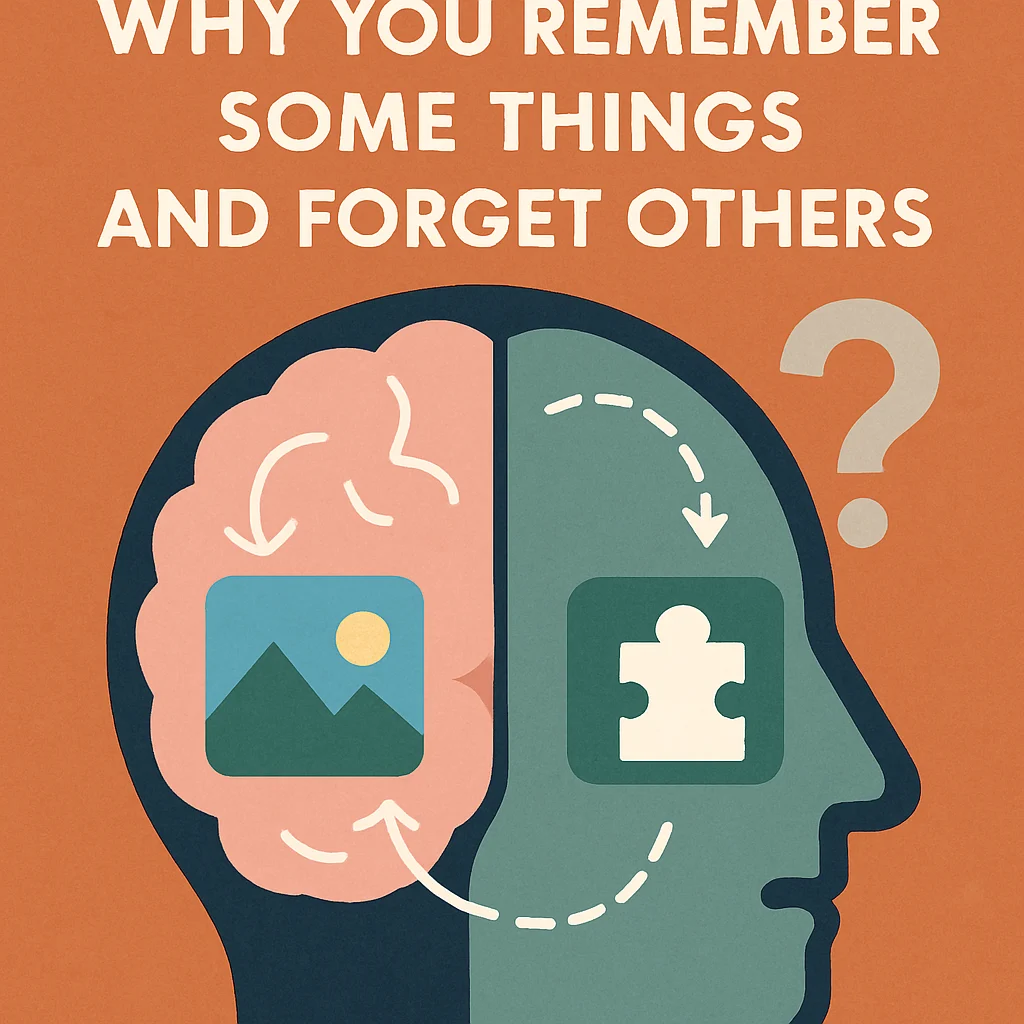
Ever ponder why you can remember the words to a song from your youth but are unable to recall where you put your keys this morning? Or why do you seem to forget entire days while certain experiences are etched into your memory?
One of the most potent and enigmatic abilities of the human brain is memory. It helps us make decisions, develop our identities, and draw lessons from the past. It is very selective, though. Why, then, do we recall some things while forgetting others?
This blog explores the science of memory — how it works, why it's selective, and what you can do to improve it.
How Memory Works: A Quick Overview
It's useful to comprehend how memory is created before delving into the reasons behind forgetting. Memory processing occurs in three major stages:
1. Encoding
This is the process by which you take in information from your senses, including sounds, smells, and sights. Whether or not something even enters your memory at all depends on encoding.
There are three types of encoding:
-
Visual encoding: What you see
-
Acoustic encoding: What you hear
-
Semantic encoding: What it means
2. Storage
Once encoded, the information must be stored. Memory storage happens in two main systems:
-
Short-term memory (working memory): Holds small amounts of information briefly (e.g., a phone number you just saw)
-
Long-term memory: retains more practiced or significant information for extended periods of time, sometimes forever.
3. Retrieval
Recalling stored information is what this is. We frequently mistake unsuccessful retrieval for forgetting, but in certain cases, the memory is still present but inaccessible.
Why Do We Remember Some Things?
Not everything gets stored in long-term memory. Several factors influence what “sticks”:
1. Emotional Intensity
Events that are emotionally charged are typically more memorable. This is because the brain's emotional center, the amygdala, improves memory encoding when you experience intense emotions like joy, sadness, or fear.
Example:
You probably don't remember what you ate for breakfast the following day, but you do remember where you were at a significant global event.
2. Repetition and Rehearsal
The likelihood that a piece of information will be retained over time increases with the frequency of its recall. This technique, which has been shown to increase retention by science, is called spaced repetition.
Example:
You've practiced the alphabet hundreds of times, so you remember it, but after hearing someone's name once, you can't remember their name.
3. Meaning and Relevance
Information that has personal meaning or relevance for us is easier for us to remember. Understanding the "why" behind something improves retention, which is related to semantic encoding.
Example:
You are more likely to remember a story about your own line of work than a random one about another.
4. Novelty
Unusual occurrences or startling facts are more likely to stick in your memory because the brain is drawn to things that stand out.
Example:
You may forget ten everyday conversations, but you will remember the one where you were taken aback.
5. Use of Multiple Senses
The use of visuals, sound, touch, or movement in multisensory learning enhances the formation of memories. Deeper encoding results from using several brain regions.
Why Do We Forget?
Why do we forget things, given the power of our brains? It turns out that forgetting is necessary and not a weakness. This is the reason:
1. Decay Over Time
This falls under Hermann Ebbinghaus's concept of the forgetting curve. He demonstrated how quickly memory deteriorates in the absence of reinforcement.
-
20 minutes after learning: You forget 42%
-
After 1 hour: 56%
-
After 1 day: 67%
2. Interference
It is possible for memories to vie with one another. Either old memories can prevent new learning (proactive interference) or new information can interfere with old memories (retroactive interference).
Example:
Because they are too similar, you may confuse your old password with your current one.
3. Poor Encoding
Sometimes we simply never encoded it correctly, so we don't truly forget. If you weren't listening when the information was presented, it wasn't saved in the first place.
Example:
Because you were preoccupied with something else during the introduction, you are unable to recall the name of someone you recently met.
4. Stress and Anxiety
The hippocampus, which forms memories, is disrupted by stress hormones like cortisol. Retrieval of memories can also be impeded by elevated anxiety.
Example:
Under pressure, you "blank out" on an exam or forget lines during a performance.
5. Lack of Sleep
The process of moving short-term memories to long-term storage, known as memory consolidation, depends on sleep. Memory retention is weakened by sleep deprivation.
Types of Memory (And Why Some Are Stronger Than Others)
Your brain doesn’t have just one type of memory. Here's how different memory systems explain why we recall some things better than others:
1. Episodic Memory
This includes recollections of particular occasions or experiences, like your wedding day. The visual and emotional context gives these their power.
2. Semantic Memory
This is general knowledge, including facts, definitions, and ideas (such as Japan's capital). Repetition makes it more resilient but less vivid.
3. Procedural Memory
These are abilities and routines, such as typing or riding a bike. Even in times of stress, they are rarely forgotten because they are ingrained in the brain.
4. Sensory Memory
Extremely short-term storage tied to sensory inputs. You usually forget this information unless it's encoded quickly.
Can You Train Your Brain to Remember Better?
Absolutely! Here are some evidence-based strategies to improve memory:
1. Use Spaced Repetition
Instead of cramming, go over the material at regular intervals over time. This method is used by apps such as Quizlet and Anki.
2. Create Associations
To connect concepts, use stories, acronyms, or mental associations.
Example:
ROYGBIV helps you remember the colors of the rainbow.
3. Teach What You Learn
Teaching someone else, or the Feynman Technique, compels you to comprehend more thoroughly and remember information better.
4. Use Visual Aids
Diagrams, charts, and mind maps give abstract concepts more substance and help people remember them.
5. Get Quality Sleep
Try to get 7 to 9 hours of sleep. The majority of memory consolidation takes place during deep and REM sleep.
6. Practice Mindfulness
Encoding is enhanced by mindful attention. You learn more from your surroundings just by being there.
Conclusion: Memory Is Selective by Design
Our brains don't have limitless storage like hard drives do. They are dynamic systems made to put some information first and ignore the rest. Your memory is influenced by:
-
Emotion
-
Relevance
-
Repetition
-
Focus
-
Sleep and health
Although you have no control over which memories you remember or lose, you can gain an advantage by knowing why your memory functions the way it does. You can learn more effectively, enhance memory retention, and develop a brain that works better for you every day if you use the appropriate techniques.